
Your basket is currently empty!
Estimation Stations
More Than a Wild Guess: Inspiring Young Estimators

We’ve all been there. You ask a child to estimate the number of sweets in a jar, and you get an answer like “a million!” or “three!” It’s easy to dismiss these as wild guesses, but what if we could turn estimation from a shot in the dark into a valuable, exciting skill?
Estimation is a superpower. It’s the ability to quickly and confidently make an educated guess about numbers, measurements, and quantities in the world around us. But how do we unlock this power in our children?
The secret lies in setting up “Estimation Stations” where children can hone their skills. Instead of asking a child to blindly guess, we can give them a simple reference point, or benchmark. A weekly estimation station can focus on different mathematical areas, making it a regular and fun part of the routine. One week, a station might feature a jar of marbles with a small, separate group of 10 marbles nearby. Before estimating the number in the big jar, ask them: “There are 10 marbles in this small group. How many do you think are in the whole jar?” Suddenly, their brains have a starting point. They can use this known measure to scale up and form a more reasonable estimate.
This same principle applies to everything from length to weight. Another week, an estimation station could have a stack of books and a single book with a clearly marked 1 cm thickness. The question becomes: “This book is about 1 cm thick. How tall is the stack of books?” or “This apple weighs about 100g. How much does this bag of apples weigh?”
The magic happens in the discussion that follows. Whether their estimate is close or far off, the conversation is what truly builds their skills.
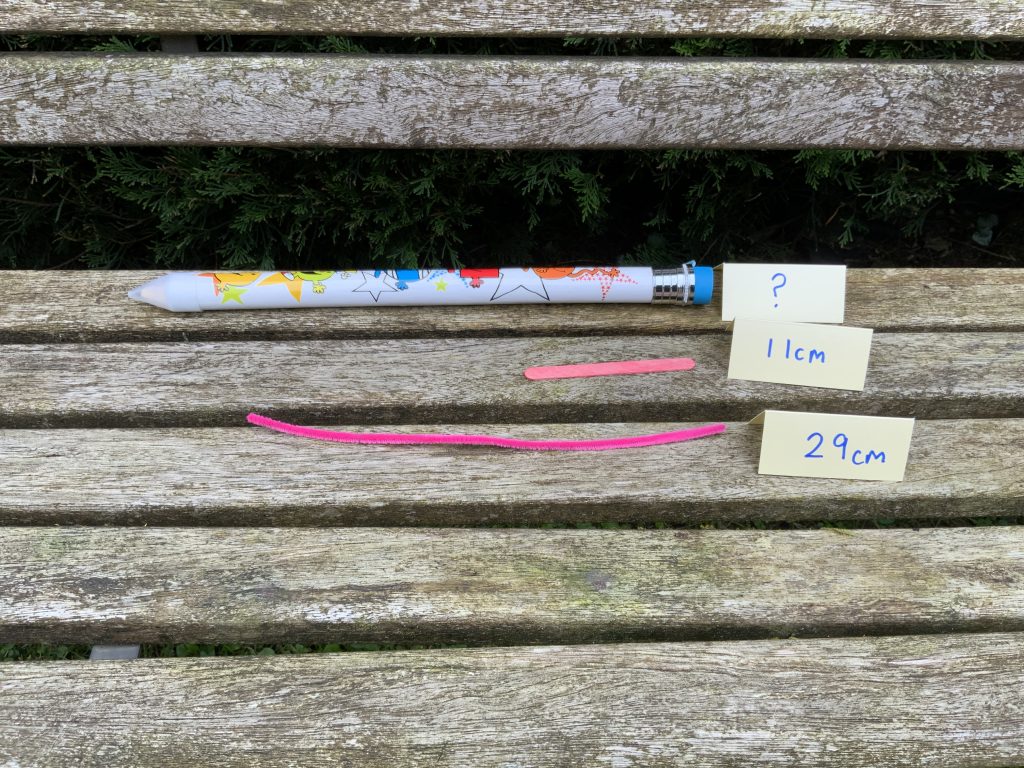
Encourage them to use a Talk partner, explaining their reasoning. Why did they choose their number? Did they count layers of sweets? Did they mentally stack the books? This peer-to-peer discussion and subsequent sharing with the group helps them develop a deeper understanding of quantities and measures, refining their own thinking as they listen to others.
So, let’s move beyond “just guessing.” Let’s empower our children with the tools to become confident, thoughtful estimators. Let’s make estimation a game of clever reasoning, not just a shot in the dark. By using Estimation Stations and encouraging rich discussion, we can transform estimation from a wild answer into an essential life skill.